


In early November, Education Progress attended this year’s annual convention for the National Association for Gifted Children. The NAGC is the leading American advocacy organization for the educational interests of gifted and talented children, and Education Progress was eager for a front-row seat to the current conversations about gifted-ed research and advocacy.
We want to highlight two standouts from these sessions that really impressed us. One is the new National Research Center on Advanced Education, which is already making huge strides in high-quality research on advanced education and actionable proposals to put it into practice. The other is the talent development framework, a promising, evidence-informed approach for connecting giftedness and gifted education to the psychology of expert performance. Both represent empirically scrupulous advances for excellence in education, and en route to Thanksgiving, both are reasons to be grateful.
Bad-news bias afflicts media coverage about advanced education just like it does media coverage generally. And there’s plenty of bad news to go around, from perennial attacks on GT programs and magnet schools and attempts to undermine ability grouping, to articles that question the very idea of high-ability students. As much as we celebrate academic excellence at Education Progress, the bias applies to us too: we tend to champion advanced education explicitly in pieces primarily about lamenting these conflicts. There are certainly positive developments worth publicizing; we were thrilled to report our survey showing that Oregon voters support dedicated funding across party lines! But if we were captive to like counts, we’d be dissuaded from sharing even that. Negative narratives strike harder, but we stress the positives when we can.

Well, today we can! From November 5th through the 8th, Education Progress attended NAGC26 in Milwaukee, WI, and we want to highlight some of the good news we took away from the sessions we attended. We liked and learned a lot that we don’t have space to cover, but it wasn’t hard to pick out our two biggest reasons for optimism about the future of American advanced education.
Our two highlights, the National Research Center on Advanced Education and the talent development megamodel, represent evidence-informed moves away from older, maladaptive notions about giftedness toward the practices and policies that give all students who are ready for challenge the advanced instruction they need.
Two guiding premises of our work are that (a) students should be taught where they are, meaning instruction should be tailored to their pace and level of learning, and (b) schools’ decisions about policy, curriculum, and instruction should be informed by evidence we have for what works.
We knew from the get-go that NAGC was on board with (a). The organization is a vocal champion for academic acceleration, flexible ability grouping, and the country’s only federal program devoted solely to gifted education. Support for gifted children is in the name, and they even featured the Oregon TAG survey in NAGC NewsSource.
We just hadn’t known where things stand with (b). It’d be convenient if gifted education professionals and advocates set higher evidentiary standards than those in other corners of the discipline, but care for advanced learners and empirical scrutiny of how they’re taught are not the same thing. The NRCAE and the talent development megamodel helped clear things up. If you want to defend high-quality advanced instruction against accusations of leveraging selection effects and laundering privilege, then these are two lodestars for showing you how.
Highlight #1: The National Research Center on Advanced Education
Amid the devastating cuts to the Department of Education, the IES awarded only a single competitive grant in 2025. The silver lining is that this was the grant to fund the National Research Center on Advanced Education. The NRCAE is a new powerhouse for high-quality research, advocacy, and policy that supports advanced learners.1 If you click on only two hyperlinks here, make the NRCAE Substack the first.
The NRCAE is moving decisively on consequential projects, including a study on the effects of automatic advanced-math enrollment in North Carolina and developing toolkits for improving identification practices in NC, NJ, and NE that “meet districts where they’re at.” The team is also committed to making research findings widely accessible through concise parent- and practitioner-facing resources. Their series of one-pagers and research brief series already boasts entries on the benefits of acceleration, the millions of students performing above grade level, and the effective use of local norms; soon it will include ones on grouping, differentiation, and more.
The NRCAE’s information session also tipped the scales for me on using “advanced education” terminology in place of “gifted and talented” — the case for which NRCAE Director Jonathan Plucker articulates here. Many are put off by the “gifted” label, and more palatable terms will provoke less resistance to policies that support advanced learners. But more worrisome is that vastly more students are ready for advanced content than are identified by existing assessments; educators and administrators ignore huge numbers of students who perform above grade level in the ill-conceived quest to locate the few truly “gifted” children. There is, in fact, there’s minimal empirical support for those lists of characteristics that all and only gifted kids are said to have. Any label that deflates perceptions of how many students need advanced instruction is a hazard. For an even stronger case, we can look forward next year to the center’s “big paper” in favor of “advanced instruction,” complete with comments from critics and responses thereto.
Especially encouraging is that the team is dead-set on closing the distance between good research and the classroom. The agenda we saw outlined plans for research-to-practice summaries on advanced math, identification toolkits, automatic enrollment implementation, and more. If you have questions of your own, there’s an “Ask the Center” page waiting for you.
Every reader who cares about excellence in education should be excited about the NRCAE. This institution has real momentum, and we can’t wait to see what comes next.
Highlight #2: The Talent Development Framework
The talent development framework is an evidence-informed approach to giftedness and advanced education based on the psychology of expert performance. It was the common thread across most of the sessions that stood out for their empirical rigor; in every case, focusing on how to develop students’ talents for lasting achievement led to more fruitful engagement with the topics at hand. If you click on only two hyperlinks here, make the foundational statement of the TD framework the second.2
The driving motivation behind talent development is to replace the traditional emphasis on inborn traits with a focus on teachable, domain-specific abilities that should not be left to chance; in a blurb, “from having gifts to developing talents.” What’s so impressive about the framework is how it manages to incorporate research insights on expertise in other domains without sacrificing a rigorously scientific pedagogy. The key tenets echo many of our own:
General ability is fundamental for talent, but domain-specific abilities become more important for achievement.
Abilities must be trained and developed into talents, and different domains have different development trajectories.
Opportunities matching students’ stage of development are necessary for turning potential into achievement.
Certain psychosocial skills are teachable and consequential for developing talent.
The goal of gifted / advanced education should be empowering talented students to turn their abilities into accomplishments and contributions.3
While general ability remains centrally important in talent development, proponents are careful to distill the folk conception of ability into distinct stages that are common across domains: potential, competence, expertise, and eminence. General intelligence is a major factor for potential in academic domains, but domain-specific abilities and more become greater determinants for achievement as students move from competence to expertise or even to eminence in a field.
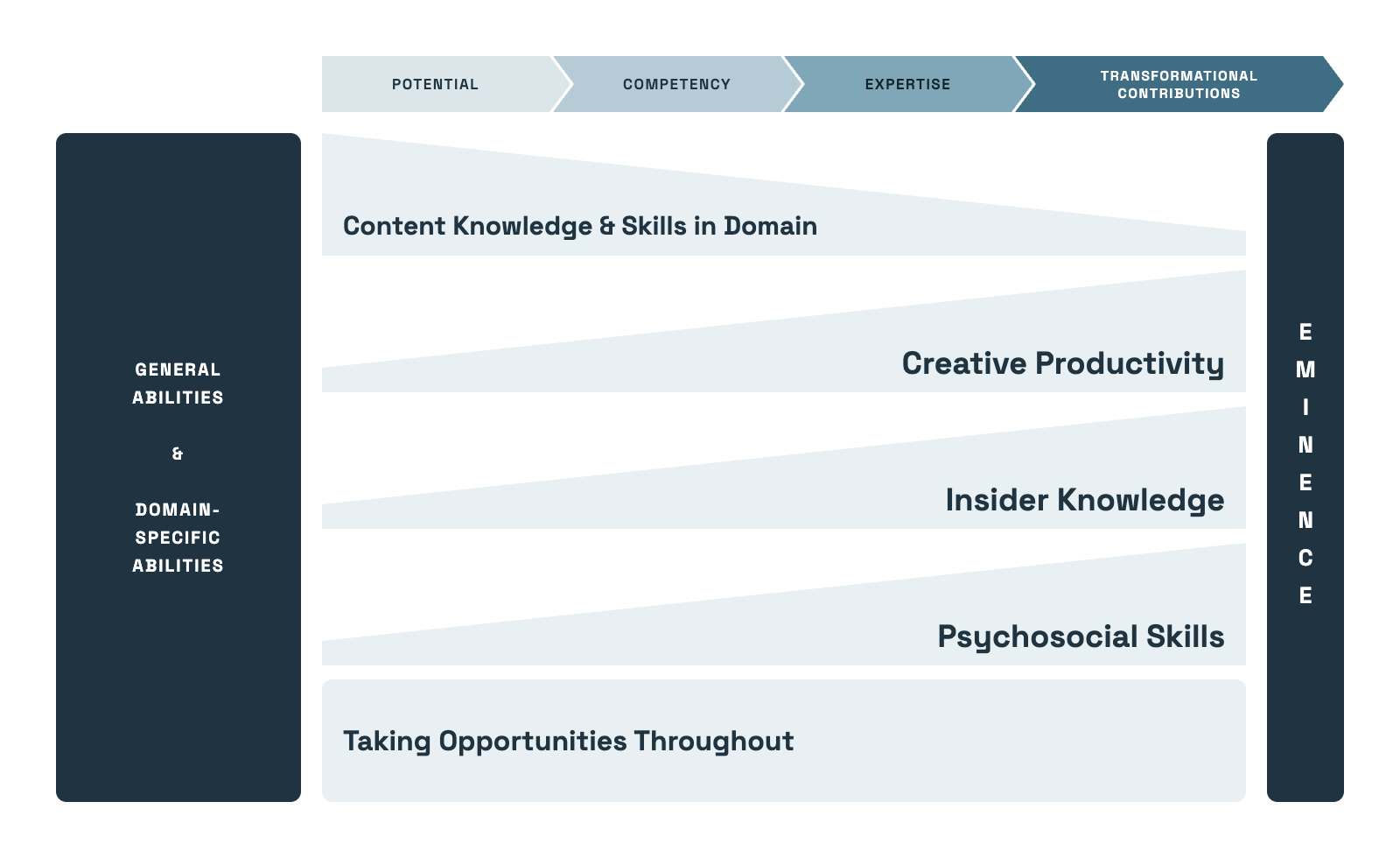
Moreover, while the TD framework stresses the value of teachable psychosocial skills including metacognition and executive function, you can see how the TD diagram above explicitly attributes those skills greater importance at later stages of development. The TD researchers harbored no illusions about the primacy of content knowledge for getting to competence; these are not the people pushing for unstructured lessons aimed at critical thinking and creativity and downplaying memorization, practice, and mastery of fundamental, domain-specific skills. Though open questions remain about precisely which skills are teachable and how best they’re taught — a caveat the presenters weren’t afraid to make — psychosocial skills are handled much more responsibly in the TD framework than are the fluffiest varieties of SEL in many classrooms.
This anecdote is representative. The first TD session I went to at NAGC26 covered MTSS for Psychosocial Skills, and I had steeled myself for woo-woo. What I witnessed instead was some of the most meticulous, qualification-rich, instructional nitty-gritty I’ve seen in a conference-talk context. When one of the presenters reached the point on a slide where “inquiry” was mentioned, she clarified to the room that “Obviously, when students are new to material, any such inquiry must be highly scaffolded.” From what I saw, the talent development faction just takes effective instruction seriously.
Well beyond the satisfactions of theoretical coherence, the TD framework entails concrete practical changes to identification and GT services. Identification practices that over-index on particular assessments of general intelligence risk missing clear demonstrations of domain-specific ability and content mastery. If we care about advancing excellence — about ensuring that all students can push as far and as fast as they’re willing to go — we need to care about identifying talent in specific domains and providing domain-specific advanced services. Students who demonstrate mastery across domains of course need more challenging instruction in each of them. But students who show talent in a smaller subset of domains likewise need more challenge in those.4
All told, for a group like Education Progress, the ascendence of the talent development wing is a trend worth celebrating. Multiple TD presenters said “Teach students where where they are” verbatim. An overview of this length can’t do justice to the full TD literature, but talent development is moving the field in the right direction.
In closing
One of the convention’s signature sessions was a panel discussion on “The Future of Advanced Education and Talent Development,” moderated by the aforementioned Plucker.5 The panel helped solidify the impression I got that advanced education and talent development are something like a coalition. Several sessions alluded to conflicting “paradigms” in gifted and talented education, and certain polite but tactful comments suggested that not so long ago, these blocs were less than wholly welcome.
One critical commentary to talent development’s seminal paper was titled “The Case for a Schism”6; in a response, the original authors write that “Gifted education has been rightly criticized for its lack of scientific rigor and atheoretical research.”7 In education, as everywhere else, “evidence-informed” is easily said and hard won. We are grateful for the practitioners, researchers, and advocates whose efforts make today’s two big highlights possible.
Lastly, we’d like to thank the NAGC for a great convention, and the many attendees who visited the Education Progress booth at NAGC26. We loved speaking with educators, researchers, and other exhibitors firsthand, and we hope you take us up on our offer to feature your writing. (Though some of you still have to completed our survey like you promised!)
Interesting to note is that the Amber Northern of the Fordham Institute, who last year was appointed senior advisor to Linda McMahon and tasked with reimagining and reforming the IES, is currently on the NRCAE Advisory Board; between Dr. Northern and being the IES’s sole competitive grant for 2025, is it too optimistic to conclude that advanced education could become a bipartisan federal priority? Probably, but oh, we can dream.
Rena F Subotnik, Paula Olszewski-Kubilius, and Frank C Worrell, “Rethinking Giftedness and Gifted Education: A Proposed Direction Forward Based on Psychological Science,” Psychological Science in the Public Interest 12, no. 1 (2011), doi.org/10.1177/1529100611418056. The most recent version of the TDMM we saw at NAGC26 was version “3.0,” but the key moves are all present, un-paywalled, in Subotnik et al. (2011).
Arrangement drawn from Rena F Subotnik, Paula Olszewski-Kubilius, and Frank C Worrell, “Talent development as the most promising focus of giftedness and gifted education,” in APA handbook of giftedness and talent, eds. S. I. Pfeiffer, E. Shaunessy-Dedrick, & M. Foley-Nicpon (American Psychological Association, 2018), 231–245, https://doi.org/10.1037/0000038-015.
Full credit for introducing me to the talent development framework goes to Dr. Tamra Stambaugh, whose October OATAG conference sessions on talent development were very informative and superbly footnoted.
If you want to splurge on a third hyperlink, the eponymous book is available here!
McBee, M. T., McCoach, D. B., Peters, S. J., & Matthews, M. S. (2012). The case for a schism: A commentary on Subotnik, Olsewski-Kubilius, and Worrell (2011). Gifted Child Quarterly, 56(4), 210-214.
Frank C. Worrell, Paula Olszewski-Kubilius, and Rena F. Subotnik, “Important Issues, Some Rhetoric, and a Few Straw Men: A Response to Comments on ‘Rethinking Giftedness and Gifted Education,’” Gifted Child Quarterly 56, no. 4 (2012): 224–31, https://doi.org/10.1177/0016986212456080.
But what about equity? Surely DEI doesn't, um, expire that easily...