


Education Progress is excited to offer a new Logic Tournament package on our website. Creator Sebastian Garren reflects on the motivations behind the development of an approachable academic competition centered on strategic, rigorous logical reasoning. Even as existing competitions present invaluable opportunities for students to grow, many students at risk of abandoning challenging fields can recommit with the right inspiration. We think Sebastian’s Logic Tournament presents a terrific source of just that.
If you are interested in hosting a Logic Tournament at your own school or have questions any questions about the competition, please reach out to us at contact@educationprogress.org.
The Schoolhouse is a series from Education Progress featuring articles for and from teachers, parents, education officials, and others working in the education system.
A few years ago, Jack Despain Zhou and I were musing about those special moments — maybe you have had one — when students are inspired to develop their intellectual potential as much as they can. I am the director and an educator at a classical high school; our students spend much more time parsing syllogisms, enjambment, and models of American growth than they do solving magic circles and mapping matrices, and our top students frequently take both AP Latin and Calculus. But I see many perfectly capable students take little interest in math. Even worse, I have known far too many exceptional students who, despite their aptitude, end up forsaking grand ambitions because they lacked the fulfillment that would keep them invested. As Jack recalled the moment during a math competition that so inspired him in his youth, I could not help but imagine ways I might cultivate more of these “Wow” moments for my students and others.
While effective schools rightly focus on teaching content knowledge and domain-specific skills, they largely leave the question of whether top students care enough to persist up to chance. High ability in mathematics is an essential foundation for expertise in many fields, even if it is not sufficient.1 Many students are deterred by their own judgments of comparative advantage or comparative ease; when highly skilled in both verbal and mathematical reasoning, students are 29% less likely to pursue a STEM path.2 Many girls with incredible potential in math are driven from the field because of social mores and peer-group participation rates. And many students are simply never exposed to opportunities for exercising their skills in a way that captures their interest.3
Academic competitions like the one that wowed Jack are terrific for mitigating the factors that too often push students away from quantitative professions. Recent research in talent development emphasizes the importance of extracurricular “opportunities to interact with talented peers” for motivating students to continue advancing in a domain when the challenges increase. To help highly capable students find this kind of enjoyment and encouragement in the type of rigorous thinking mathematics provides, I wanted to draw on my experiences running a classical high school to foster a new kind of academic competition.

But data from the American Mathematics Competitions (AMC) suggest that existing math competitions have their own pitfalls. Consider the many girls with incredible math potential: a 2018 study found that among students who fall just shy of advancing to the second AMC exam, girls more often than boys react by dropping out of future years altogether.4 Whether the decisive factor for this “discouragement effect” is lower peer-group participation or overall inadequate support, even our highest-ability young women are self-selecting out of precisely the kind of opportunities they would need to stay engaged. Whatever rigorous competition I would craft, I needed one that played to our students’ strengths and the school’s educational tenor, but also one that was fun, broadly appealing, and approachable for the kind of students who have, for whatever reason, learned to chafe at the idea of competing in math.
A great model for the kind of competition I wanted I found in the North American Computation Linguistics Olympiad (NACLO), a contest for middle and high school students to solve linguistics puzzles, for which no prior knowledge of linguistics or second languages is required. Contestants receive data from an unfamiliar language and vie to deduce the rules. Problem types include translation, number systems, writing systems, calendars, kinship systems, phonology, speech transcription, and computational and formal problems. Vitally, though the data are not numerical, NACLO problems demand many of the same habits of mind involved in rigorous quantitative reasoning, such as determining patterns and rules and manipulating abstract symbols.
So I set about creating a competition that would emphasize scrupulous logical reasoning, the kind that underlies so much serious quantitative work. Participants would enjoy strategic thinking in both team and individual settings, without needing the extensive background training or onerous concept mastery that some competitions require. I sought out engaging logic problems and puzzles from sources as diverse as the LSAT’s now-retired Logic Games section, medieval Obligationes, Lewis Carroll’s The Game of Logic, Knights and Knaves, and the long didactic passages in Neal Stephenson novels.
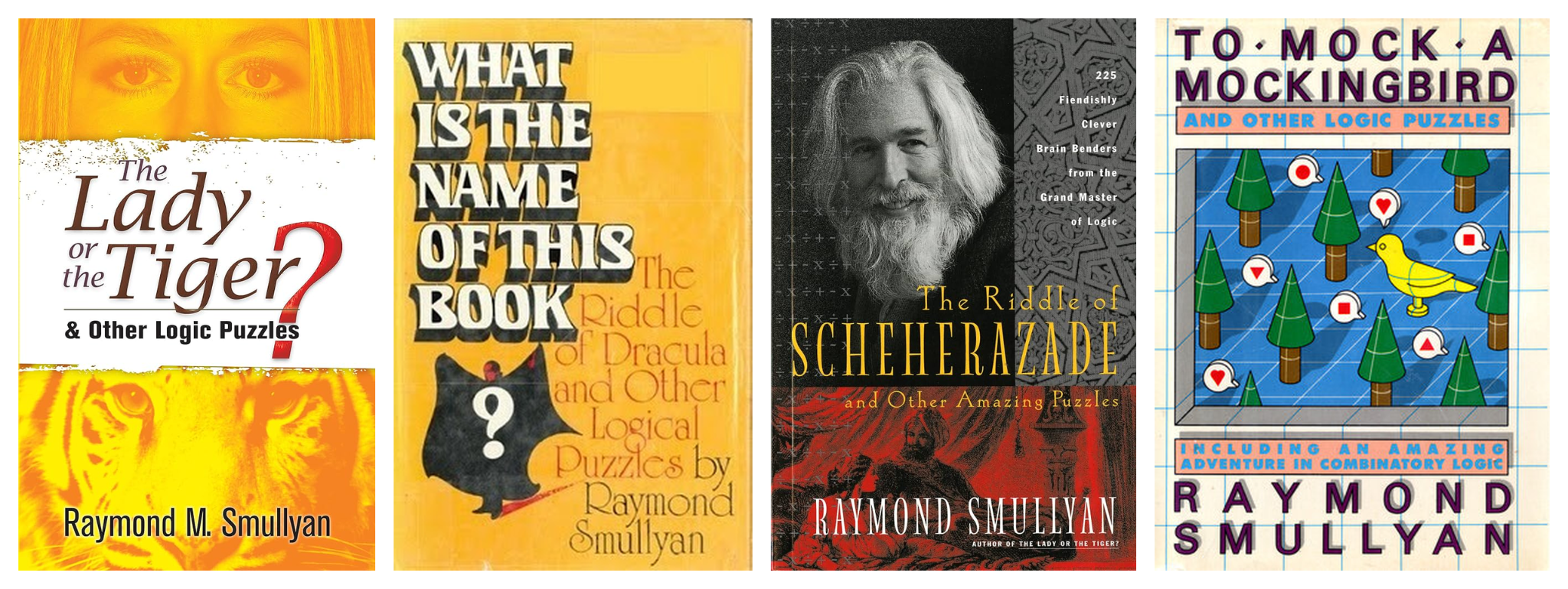
Along the vein of these types of problems, I found a great treasure trove in the books of logician and mathematician Raymond Smullyan, who offers logic problems so humorous and narrative-driven that they can delight even the students they stump. In the introduction to one of his delightful works, Smullyan recounts a father who mailed to say that his son who hates math nevertheless loved Smullyan’s books — and the father had yet to reveal that the problems are mathematical in nature! The trial-year tournament soon coalesced around Smullyan-style problems and branched out from there.
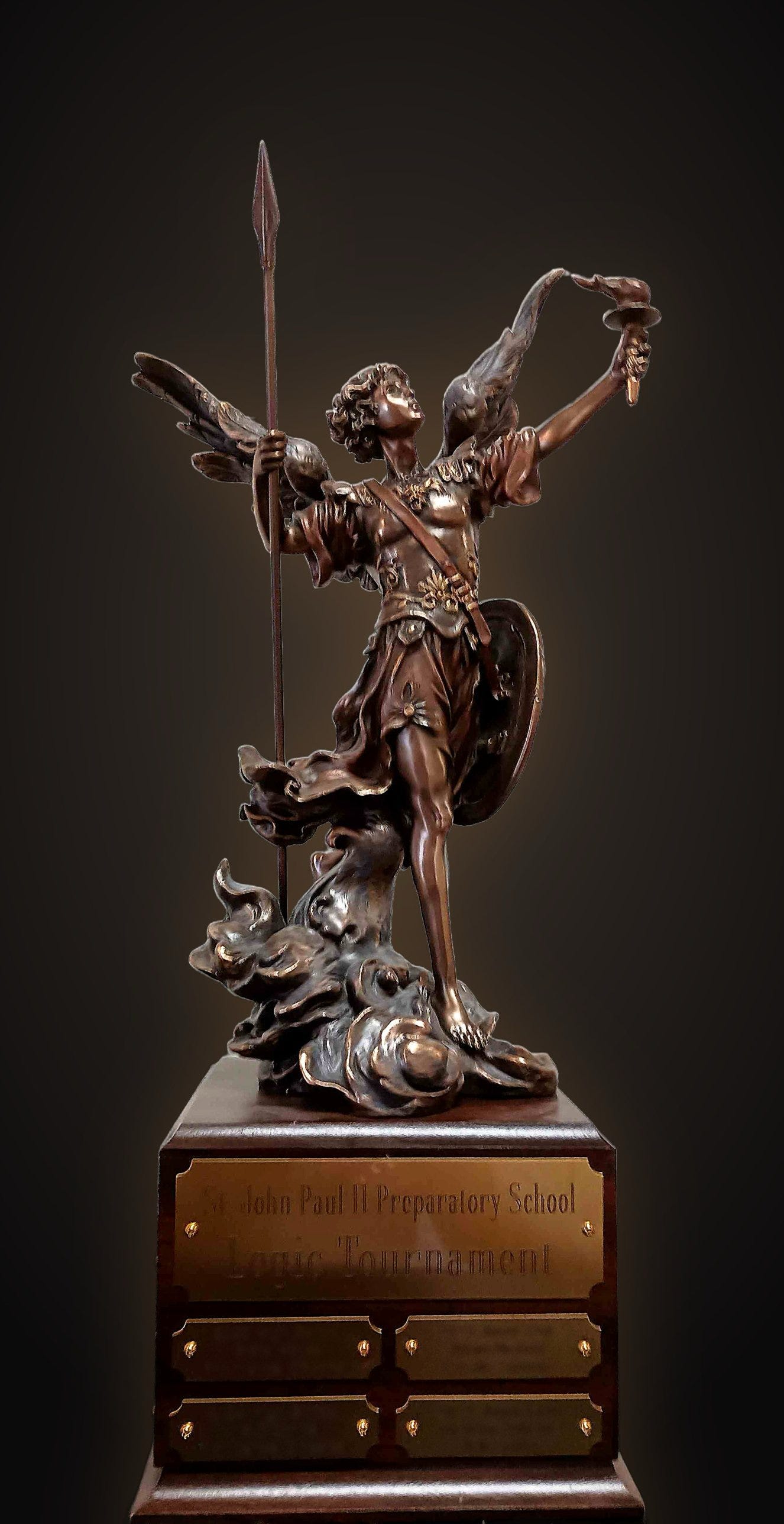
While the tournament today is more refined than when it started, the structure remains largely the same. First, students participate in a one-hour team round, in which teams of two or three solve a themed problem set together. Second, students participate in a one-hour individual round, separately solving a new problem set based on a different theme. Correct answers scored two points, blank answers scored half a point, and incorrect answers scored zero. I wanted to incentivize strategic behavior in answering questions as well in solving the problems. (One year we took it so far as to make the final question, “How many questions did you get right this round?”) We offer three sets of questions for three grade-level groups spanning 5th through 12th grade. For prizes in the first year, we offered about $600 worth of gift certificates to a local bookstore, the winner’s name inscribed on a trophy, and placement ribbons.
The buzz of excitement and hushed whispers as teams coordinated on solutions, the sound of pencils scribbling against paper, the raised hands for clarifying questions, the giggles and guffaws at preposterous scenarios and humorous answers, the urgent dignity of minds at work — the finest delight for an educator — was right there to behold. Most importantly, our students had enough fun that, despite some printer snafus and late arrivals, we eagerly hosted the tournament again the next year.
Over our four years running the tournament we have refined a great deal. We are grateful to Smullyan for supplying many of our earliest questions, but now all questions are either written by the team ourselves or submitted for our review; moreover, we share a much sharper sense for how long students across ability levels spend on solving different types of problems.5 Our moderators now have clear guides that outline the licit and illicit ways they can help, and fewer competition-day inquiries arise now that we have improved at spotting ambiguous wordings in advance.
Now that the Logic Tournament has partnered with Education Progress, we are able to cast a larger net than ever before for soliciting new problems. Right now, the most recent Tournament Package is available for purchase on the Education Progress website. In addition, the previous year’s 2024 question sets, answer sets, and scoresheets are available to download for free. We want any school or organization interested in hosting its own Logic Tournament to be able to do so.
If you would like to submit questions for review, email them to us and we will add you to the group. We are also eagerly recruiting more judges of questions. If you would like to be a judge, email me at sgarren@educationprogress.org.
Rena F Subotnik, Paula Olszewski-Kubilius, and Frank C Worrell, “Rethinking Giftedness and Gifted Education: A Proposed Direction Forward Based on Psychological Science,” Psychological Science in the Public Interest 12, no. 1 (2011), doi.org/10.1177/1529100611418056.
Ming-Te Wang, Jacquelynne S Eccles, and Sarah Kenny, “Not lack of ability but more choice: individual and gender differences in choice of careers in science, technology, engineering, and mathematics,” Psychological Science 24, no. 5 (2013), doi.org/10.1177/0956797612458937.
Rena F Subotnik, Paula Olszewski-Kubilius, and Frank C Worrell, “The Talent Development Megamodel: A Domain-Specific Conceptual Framework Based on the Psychology of High Performance,” in Conceptions of Giftedness and Talent, ed. Robert J Sternberg and Don Ambrose (Palgrave Macmillan, 2021), 425–442, doi.org/10.1007/978-3-030-56869-6_24.
Glenn Ellison and Ashley Swanson, "Dynamics of the Gender Gap in High Math Achievement," NBER Working Paper no. 24910 (2018), doi.org/10.3386/w24910. See also Glenn Ellison and Ashley Swanson, "The Gender Gap in Secondary School Mathematics at High Achievement Levels: Evidence from the American Mathematics Competitions," Journal of Economic Perspectives 24, no. 2 (2010), doi.org/10.1257/jep.24.2.109.
Special thanks go out to Matt Cole, the chief logician proofreader for year three, and Sam Enright, Zhengdong Wang, and many others for their past great problem submissions. Jack Despain Zhou himself lent his powers to the tournament last year, helping to craft some deliciously rococo love triangles and alchemical algorithms that made for an excellent question set.