


Notes & Letters [ x Model Policy] and other miscellaneous updates from Education Progress.
When we started Education Progress in February last year, we outlined a broad set of goals for the organization:
“To understand the core features of schools and learning communities that allow students to pursue excellence, to map out and execute a step-by-step plan to get there, and to tear down every cultural, policy, or information barrier in the way.”
It was only a matter of time before some of our work would have to move beyond Substack. It will continue to be our home for news, persuasive arguments, and our long-form investigations (now at news.educationprogress.org). But, as we have grown, we have realized that advancing a pro-excellence agenda requires not only a place for arguments but an infrastructure to support them.
That is why today we are launching a new site. Substack will remain the narrative center of our organization, while educationprogress.org will serve a different function. It will house the materials that underpin our positions— the academic research, the data, and the tools that give these conversations something to stand on. Several projects are coming over the next few months, but our first is ready today: the Gifted Education Policy Map.

Because our goal is to move education policy closer and closer to a reality where every student can pursue accelerated and advanced academics, if capable and interested — that is, excellence for all students — we first needed a wide picture of the policy landscape as it exists today. In the United States, education is delivered and managed by districts and states, not any national entity. It is a local endeavor in a national conversation, dependent in part on federal funds and beholden to several robust civil and constitutional rights regimes.
These federal education protections — living in statutes like EEOA, ESEA, and IDEA — do wonders for the educational rights of English language learners and students with disabilities. But there are no equivalent federal educational rights regimes for students who are gifted or advanced.

As a result, parents, educators and policymakers nationwide encounter two dilemmas:
Resources and opportunities for gifted and advanced education exist across roughly 50 separate frameworks and policy regimes, making it difficult for stakeholders to pool information or draw cross-state comparisons.
Latent national interest thus also has a tendency to be dispersed or channeled locally, further disincentivizing national lobbying or research programs.
Over the past eighteen months we have connected with many parents, educators, journalists, and researchers. Early on, a former K–12 educator pointed out something crucial: the policies that govern what schools can and must do for their highest-achieving students vary enormously from state to state, and almost no one has collected or mapped them all out.
Our first big research project thus became collecting and confirming every state-level regulation that expands or limits access to gifted and advanced education.
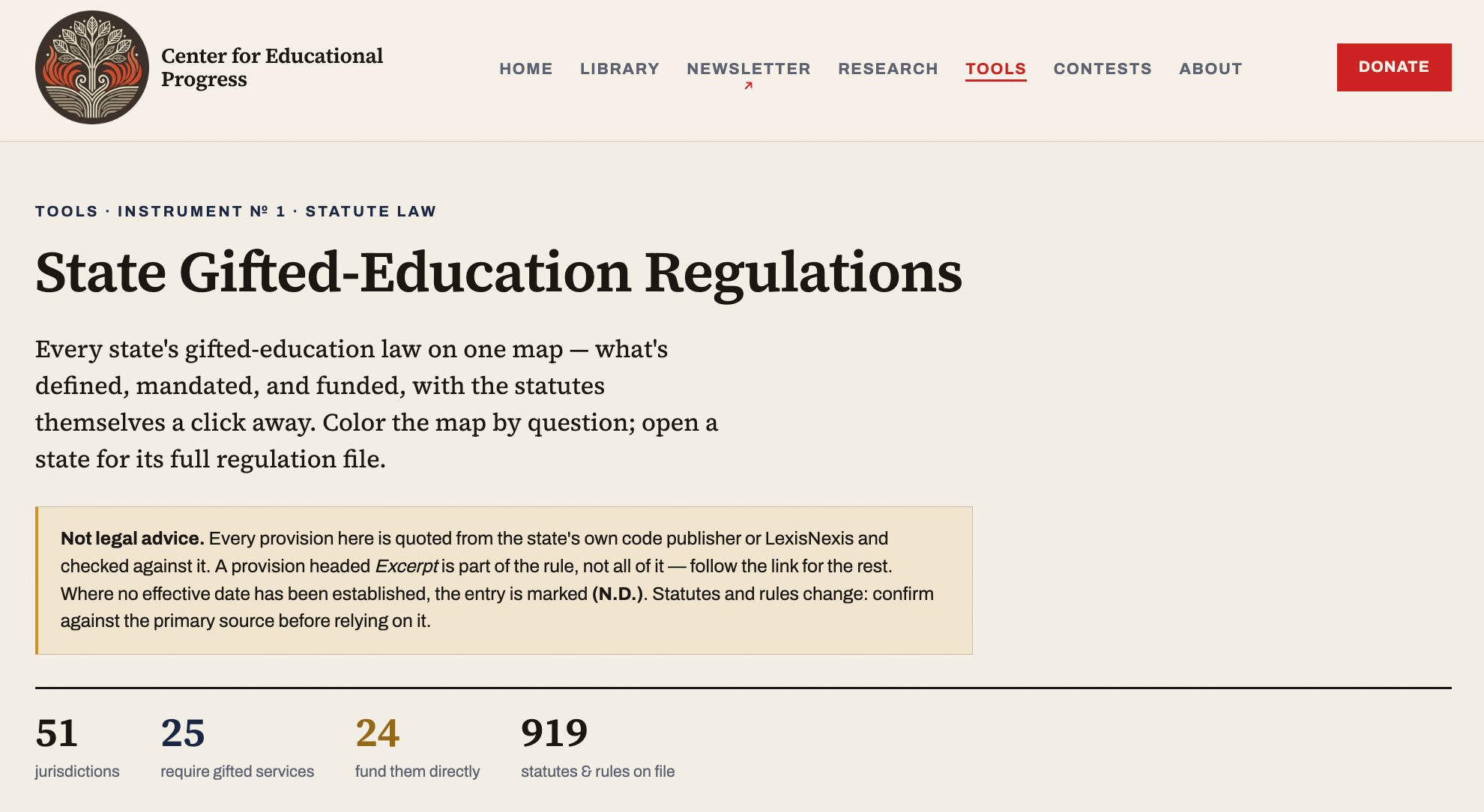
This work is now live on our site. It is an interactive map and searchable database of 919 unique verified statutes, regulations, mandates and funding provisions that govern gifted and advanced academic programming across all 50 states, plus the District of Columbia. We found them all, linked to them here, and reviewed them to ensure each one is live, accurate, and verified against its state’s codes. The entries are also linked to their relevant primary source: the state code, the state education agency’s regulations, or the state budget. These distinctions matter: statutes are set by legislatures, rules by agencies, and funding by appropriations, so knowing where a provision lives tells you who has the power to change it.1
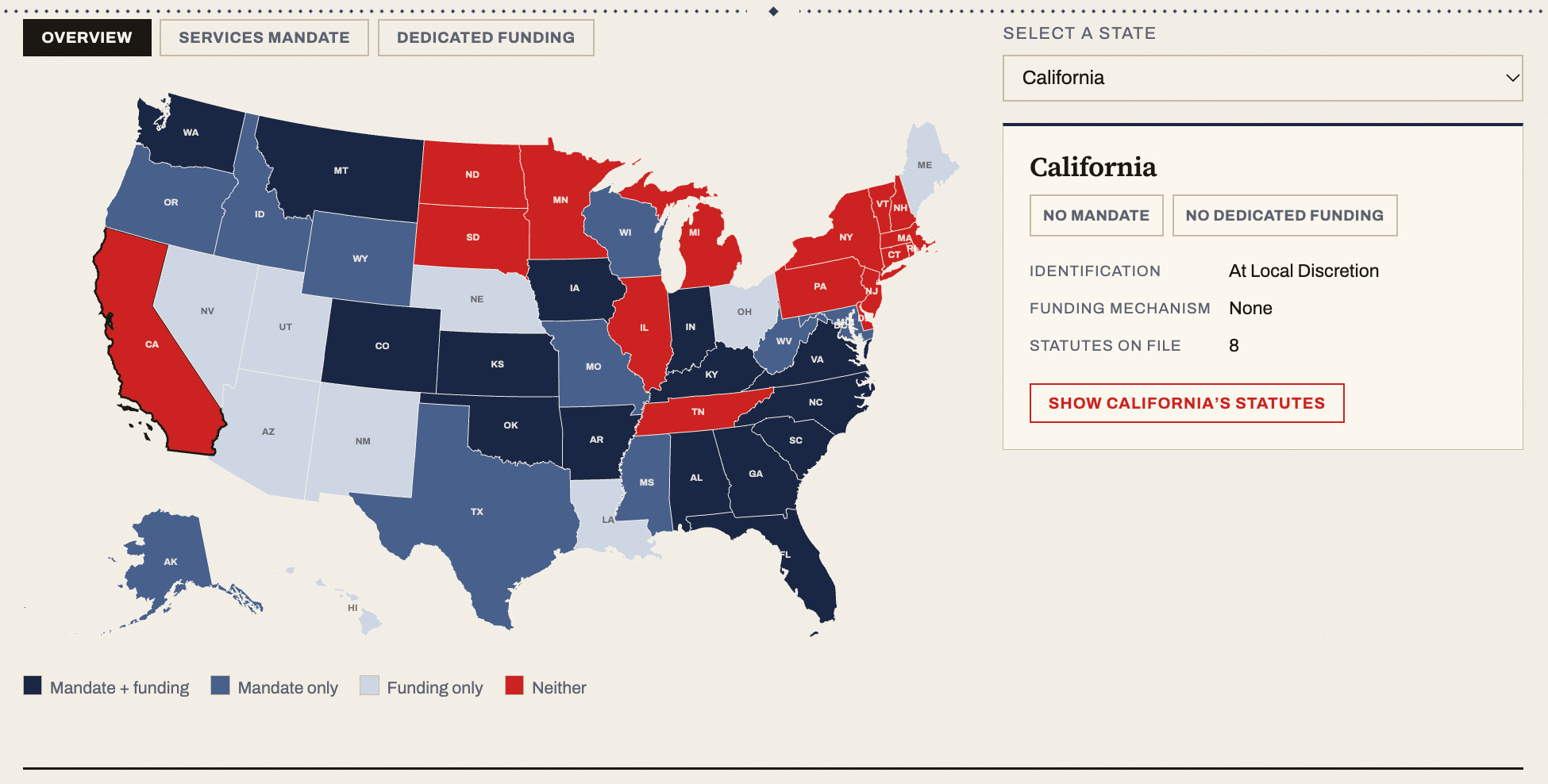
We wanted the map to indicate two important realities of gifted and advanced education in each state:
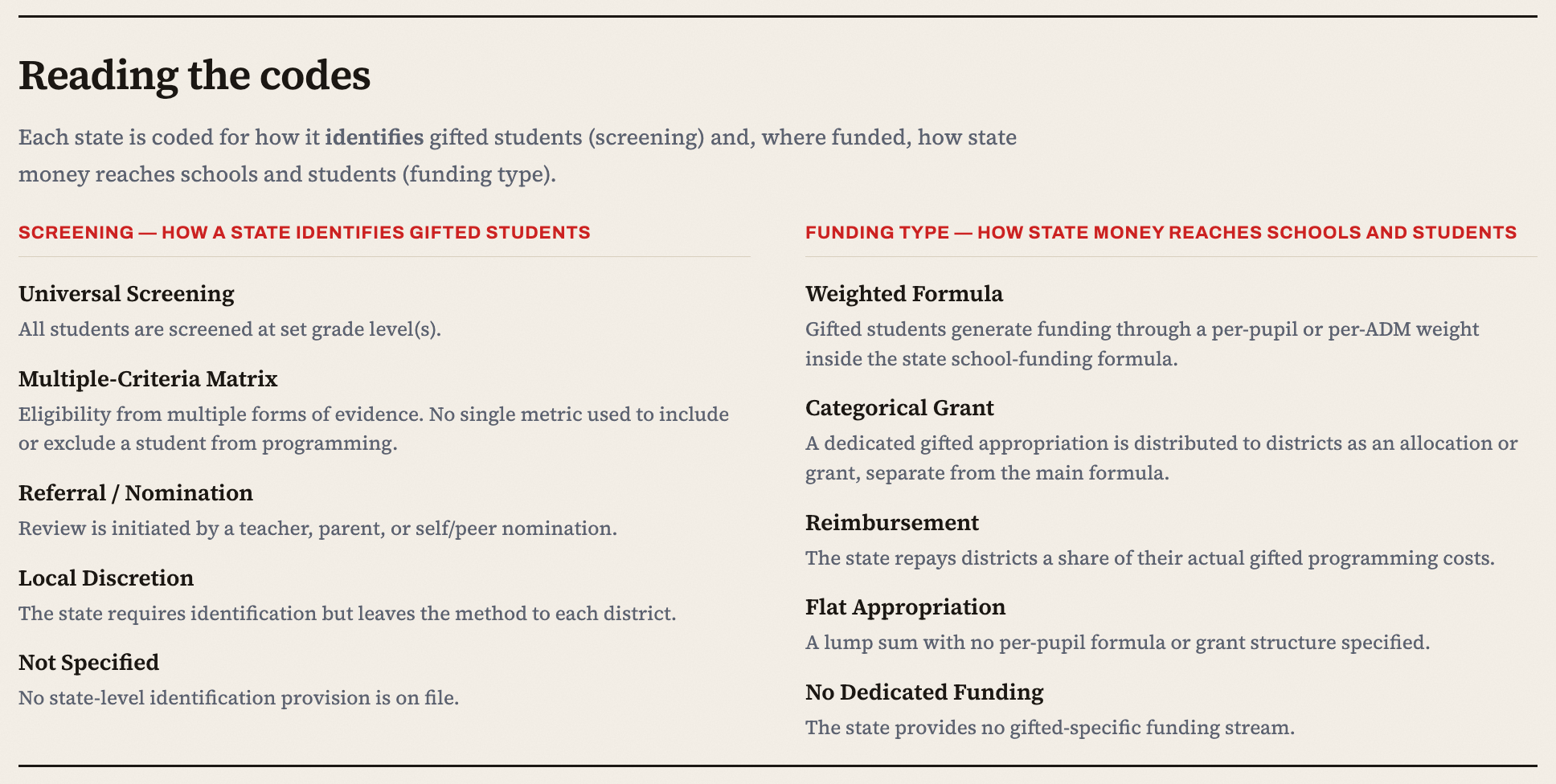
How gifted students are identified, and
How they are funded.
These levers tell us how educational power is wielded by the 13,000+ local school districts, and how support for gifted and advanced ed is mandated, funded, and defined by each state’s unique regulatory framework.
The GT Policy Map will continue to be a work in progress, but there are a couple ways you can help us make it even better. First, if you find something incorrect, inaccurate, or outdated, please report corrections by emailing us. Second, if you have some real experience securing (or failing to secure) access to gifted or advanced education in your state and/or local community, we would love to hear from you about it. Especially so if the story reveals a disconnect between the policy and the practice of gifted and advanced education in your community.
The longer-term plan for the GT Policy Map is for it to be the first in a broader suite of easy to use, up to date, and widely accessible education research tools. Hence we also welcome additional ideas about the types of tools and resources you think are missing from the policy space, especially when it comes to gifted and advanced education.
Lastly, we have several projects that explicitly support student advancement in the works, including more on academic competitions and curated K-12 booklists for advancing knowledge. In the meantime, thank you for all the support over the past two years — we look forward to even better things ahead!
While we verified each of the tool’s statutes, the tool does not provide legal advice.